Project controls health is measured by your organization’s ability to trust its project data, processes, systems, and forecasts enough to make timely, informed decisions.
In short: Healthy project controls aren't a schedule and a monthly report — they're a connected framework across people, process, data, and technology that tells you where a project stands today, where it's headed, and where to act before a small issue becomes an expensive one.
For project owners and developers, institutions with capital expenditures, utilities challenged with growth and expansion along with the need for routine shut – downs and maintenance, contractors in the constant cycle of project management - improving project controls health can reduce time, cost, and risk. Improving project control health involves utilizing the right mix of optimized software, customized processes, skilled specialists, and utilizing a trusted consultant.
What Makes Project Controls “Healthy” & How does this affect your Organization and your Projects.
Project controls health starts with one fundamental question: can you trust what your project data is telling you?
An organization may have Primavera P6, a PMIS, cost management tools, and dashboards in place, and still not have healthy project controls. Technology alone doesn't create them — the people, processes, data, and technology behind those systems have to work together, and each one is a lever your organization can actually pull.
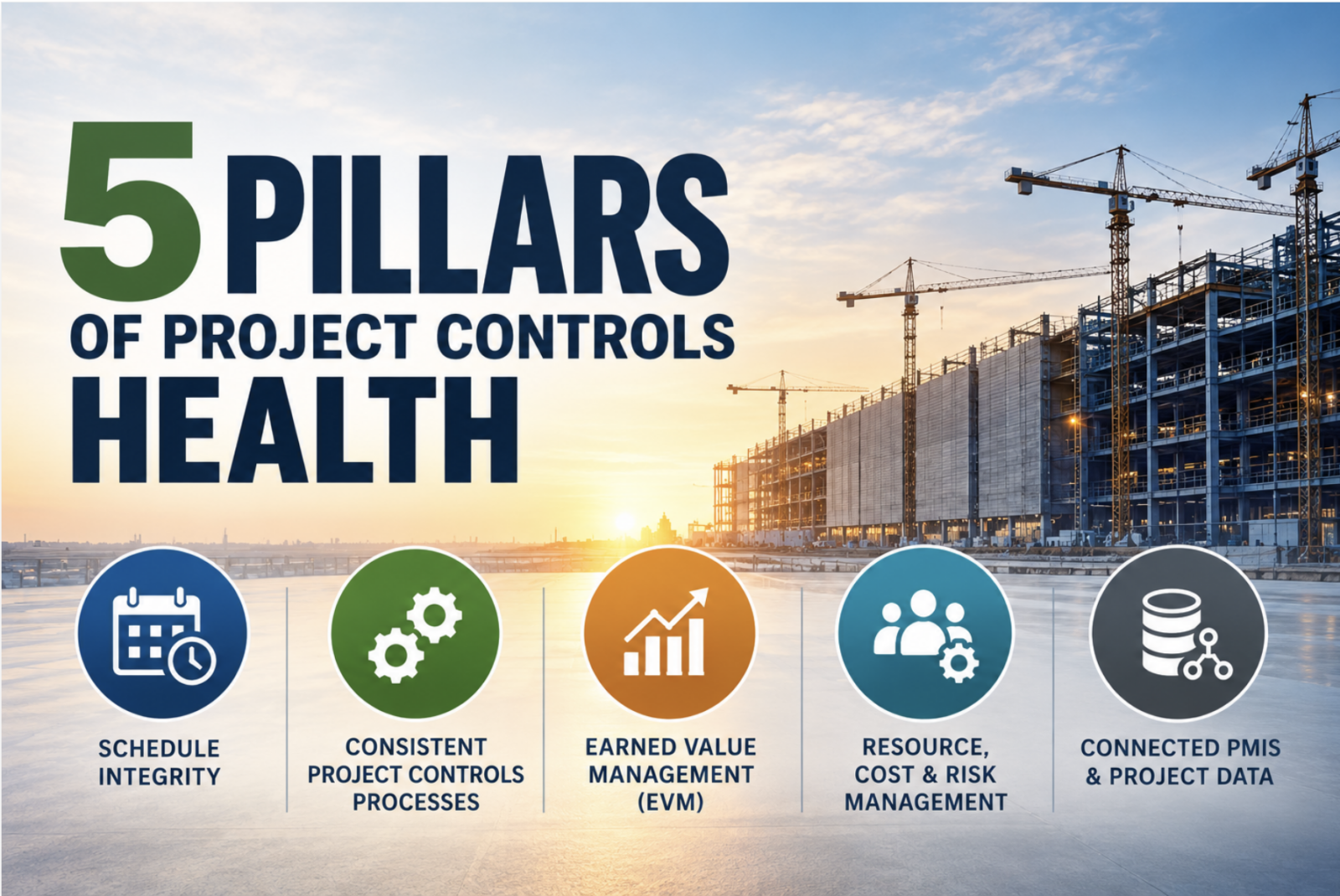
Five areas provide the strongest indication of overall project controls & project managment health:
1. Schedule Integrity
A schedule should be more than a collection of activities and dates — it should be a realistic representation of how the project will be delivered.
Regular P6 integrity checks can help identify issues with logic, constraints, relationships, progress updates, calendars, and other schedule elements that affect the reliability of forecasts.
When schedule integrity is strong, teams have greater confidence in milestone dates, critical paths, and projected completion.
2. Consistent Project Controls Processes
Healthy organizations build repeatable, standardized processes for how projects are planned, updated, reviewed, and reported — customized to their portfolio of business or industry expertise.
If every project manager or scheduler follows a different process, leadership struggles to compare projects or understand portfolio performance.
Standardized, right-sized processes create consistency while helping teams identify issues earlier and communicate performance more effectively.
3. Earned Value Management (EVM)
Earned Value Management brings schedule and cost performance together for a clearer picture of project progress.
Metrics such as Schedule Performance Index (SPI) and Cost Performance Index (CPI) — as defined by the Project Management Institute (PMI) — show whether work is progressing according to plan and whether actual performance still supports the current forecast.
The real value, however, is not simply calculating the metrics. It is using them to understand performance and make better decisions. It starts with trusting the accuracy of the information entered into the system that is built from integrity and consistency.
4. Resource, Cost, and Risk Management
Schedule health cannot be evaluated in isolation.
Organizations also need visibility into:
Whether resources are available when the schedule requires them
Whether costs are trending according to plan
Whether risks are being identified early enough to respond to
Connecting these areas — rather than tracking them in separate spreadsheets or systems — gives a far more complete picture of project performance.
5. Connected PMIS and Project Data
Many organizations have significant amounts of project data but still struggle to access useful information.
A strong Project Management Information System (PMIS) environment should connect project information — scheduling, cost, resource, risk, and reporting — rather than create another silo.
When those pieces work together, stakeholders spend less time gathering data and more time using it.
“Not sure which of these five areas is your weakest link? Schedule your free 20-Minute Performance Snapshot and we can help you identify which area may need reinforcement”
What Are Top-Performing Organizations Doing Differently?
Top-quartile project organizations do not simply collect more data. They develop the discipline and processes needed to turn that data into actionable information.
Establish consistent, customized project controls standards
Regularly evaluate schedule and data integrity
Connect cost and schedule performance
Actively manage resources and risks
Use technology to improve visibility rather than add complexity
Most importantly, they treat project controls as an ongoing management function, not a report produced at the end of the month.
That's a shift from asking “What happened?” to asking “What is likely to happen next, and what can we do about it?” — and that's where strong project controls have the greatest impact.
How Healthy Are Your Project Controls?
At Innovative Management Solutions, Inc. (IMS + CBA), we help owners, contractors, and project controls professionals evaluate and strengthen the people, processes, data, and technology behind their projects — through our partnerships with Oracle, PMWEB, Schedule Validator, Schedule Reader, Load Spring, Project controls Staffing expertise, and our internal consultants adapt at schedule software training, implementations, setting up your environments, integrity checks, or AI/BI reporting needs.
From P6 integrity and scheduling processes to EVM, resource and cost management, risk management, PMIS environments, and reporting, the goal is the same: identify where improvements can reduce time, cost, and project failure risk.
Not sure where your organization stands? Schedule your 20-Minute Performance Snapshot and discover opportunities to improve efficiency, visibility, and results.
Frequently Asked Questions (new section)
What is project controls health?
Project controls health is the ability of an organization to trust its project data, processes, systems, and forecasts enough to make timely, informed decisions. It's not the same as simply having a schedule, a PMIS, or monthly status reports — an organization can have all of those tools and still lack healthy project controls if the people, processes, data, and technology behind them don't work together. When project controls are healthy, leadership can trust milestone dates, cost forecasts, and risk exposure well enough to act before small issues become expensive ones, rather than discovering problems after they've already affected schedule or budget.
What are the 5 indicators of healthy project controls?
Five areas provide the strongest indication of overall project controls health: schedule integrity (whether the schedule's logic, constraints, and progress updates hold up to scrutiny); consistent, standardized project controls processes across the portfolio; Earned Value Management (EVM), which connects schedule and cost performance; resource, cost, and risk management, evaluated together rather than in isolation; and a connected PMIS environment where scheduling, cost, resource, and risk data work together instead of living in separate silos.
What is Earned Value Management (EVM) used for?
EVM combines schedule and cost performance data — primarily through the Schedule Performance Index (SPI) and Cost Performance Index (CPI), as defined by the Project Management Institute (PMI) — to show whether a project is progressing according to plan and whether actual performance still supports the current forecast. An SPI or CPI below 1.0 signals the project is behind schedule or over budget relative to the plan. The real value of EVM isn't calculating these metrics, though — it's using them, alongside qualitative judgment, to understand performance and make better decisions before a variance becomes unrecoverable.
Why does schedule integrity matter for capital projects?
A schedule with weak logic, broken constraints, dangling activities, or inconsistent progress updates produces unreliable forecasts — even if the schedule looks complete on the surface. Regular P6 integrity checks review logic, constraints, relationships, progress updates, and calendars to catch these issues before they distort milestone dates and critical path calculations. On capital-intensive projects, where schedule slippage carries direct cost and contractual consequences, that reliability is what allows owners and contractors to trust the dates they're reporting to stakeholders.
How do I know if my organization's project controls are healthy?
A short diagnostic is usually the fastest way to find out — reviewing all five areas (schedule integrity, process consistency, EVM, resource/cost/risk management, and PMIS connectivity) against how your organization actually operates today, not just what your tools are capable of. IMS + CBA's 20-Minute Performance Snapshot walks through this framework to identify where the biggest gaps are and where the people, process, data, or technology behind your project controls need the most attention.